





A multi-zone mini split runs two or more indoor units off one outdoor unit; a single-zone runs one. That one difference decides your upfront cost, your electric bill at part load, and what happens on the day a compressor fails. This guide explains how each configuration delivers comfort and efficiency, which one fits common Los Angeles homes, and the cases where we tell customers not to buy the multi-zone they came in asking for.
Key takeaways
- Multi-zone = one outdoor unit feeding 2–5 indoor heads on most Daikin systems, and up to 8 on the largest Mitsubishi Electric MXZ outdoor units. Every head has its own thermostat.
- Single-zone = one outdoor unit, one head. Many 9,000–12,000 BTU single-zone models run on 115V, so a garage, ADU, or sunroom conversion often needs no panel upgrade.
- On a standard multi-zone, all heads must run in the same mode (heat or cool) at the same time. That matters on marine-layer mornings in the South Bay.
- Turning zones off saves energy, but a multi-zone outdoor unit has a minimum output. One small bedroom head running alone on a big outdoor unit is the least efficient way to own a mini split.
- Rebate eligibility depends on whether your home is in LADWP or Southern California Edison territory, not on which configuration you pick.
What is a multi-zone ductless system?
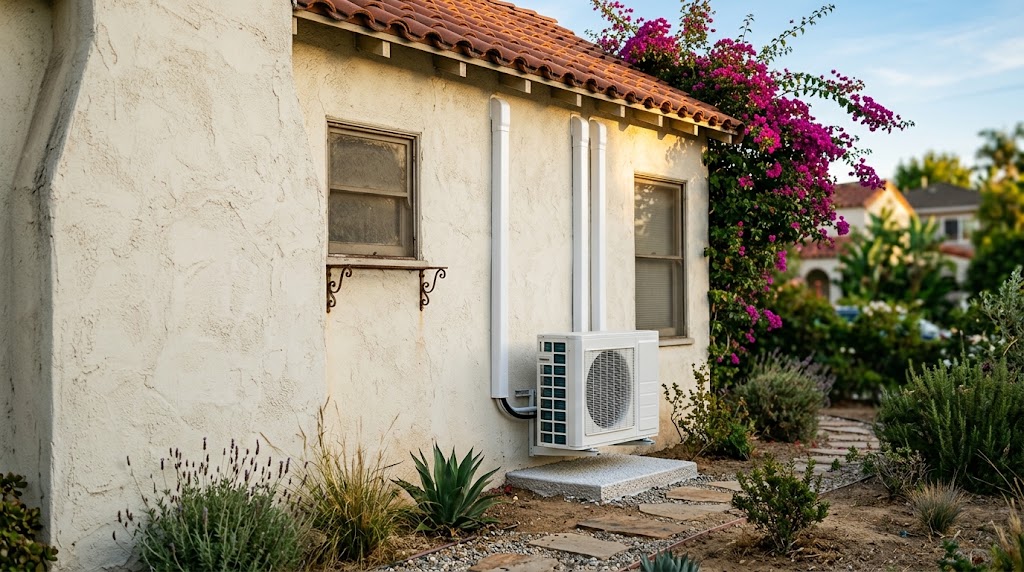
A multi-zone ductless system connects one outdoor condenser to several indoor units through separate refrigerant line sets, and each indoor unit has its own temperature control. The outdoor unit’s inverter compressor ramps up and down to match the combined demand of whichever heads are running. Indoor units can be wall-mounted, floor-mounted, ceiling cassettes, or slim-duct units hidden above a ceiling, so a single outdoor unit can serve a living room, two bedrooms, and a home office without any of them sharing a thermostat.
Definition: A zone is any space with its own indoor unit and its own setpoint. A three-zone system has three indoor units on one outdoor unit. A “dual-zone” or “2-zone mini split” is simply the smallest multi-zone.
The all-electric heat pump design works in both directions. The same equipment that cools a Long Beach bedroom in September heats it in January, and because there is no ductwork, there are no duct leaks bleeding conditioned air into an attic or crawlspace.
Multi-zone vs single-zone: the actual differences
The two configurations use identical components; the difference is how they are grouped. The table below is the comparison we walk customers through at the showroom.
| Factor | Single-zone | Multi-zone |
|---|---|---|
| Outdoor units | One per room served | One for 2–8 rooms |
| Independent temperature per room | Yes | Yes |
| Heat in one room while cooling another | Yes (separate systems) | No on standard multi-splits; all heads share one mode |
| Efficiency when only one room is running | Highest — unit is sized for that room | Lower — outdoor unit can’t throttle below its minimum output |
| Redundancy if the outdoor unit fails | Other rooms unaffected | Every connected room loses service |
| Electrical | Many 9k–12k BTU models available in 115V | 230V circuit required |
| Exterior footprint / HOA and coastal rules | One condenser per room — more to place and screen | One condenser — easier in tight side yards and HOA communities |
| Typical fit in LA | Garage or ADU conversion, one hot upstairs room, home office | Whole-house retrofit of a no-duct bungalow or post-war stucco home |
How multi-zone systems keep energy use low
Multi-zone systems save energy because you only condition the rooms that are occupied, and the inverter compressor scales its output to that demand instead of running flat-out. Switch off the two bedroom heads during the day and the outdoor unit slows down to serve only the living room. The U.S. Department of Energy notes that ductless systems also avoid the energy lost through ducts, which in a typical duct run can account for a meaningful share of cooling energy.
The catch most comparison articles skip: every multi-zone outdoor unit has a minimum capacity it cannot throttle below. If you install a large outdoor unit to cover four rooms but spend most evenings running only a 9,000 BTU bedroom head, the outdoor unit is working well below its efficient range and may cycle on and off.
Our rule of thumb from installs across Torrance, Redondo Beach, and Pasadena: if one room will run alone for most of the day, and that room’s load is under about a quarter of the outdoor unit’s rated capacity, pair it with its own single-zone instead and put the remaining rooms on the multi-zone.
Brand matters here. Mitsubishi Electric Hyper-Heating (H2i) MXZ outdoor units and Daikin multi-zone condensers both use variable-speed inverter compressors, but their minimum outputs and the number of heads they support differ by model. A Manual J load calculation for each room, not a square-footage guess, is what tells us which outdoor unit and which combination of heads will actually run in the efficient band. That calculation is part of every Dr. Ductless estimate.
Single-zone systems for garage, ADU, and addition conversions
A single-zone mini split is the standard way to heat and cool a converted garage, attic, ADU, or sunroom in Los Angeles because it needs no ductwork and often no electrical panel upgrade. Daikin reports that more than half of U.S. homes have an enclosed garage, and in LA that garage is frequently turned into a gym, office, or a rentable accessory dwelling unit under California’s ADU laws. Once a space becomes habitable, California Residential Code requires a permanent heating source capable of holding 68°F, so “I’ll just use a space heater” is not an option on a permitted conversion.
Three things make single-zone the right tool for these projects:
- 115V models. Many 9,000 and 12,000 BTU single-zone systems from Daikin and Mitsubishi Electric run on a standard 115V circuit. On older Lawndale, Gardena, and Hawthorne homes with 100-amp panels, that can be the difference between a one-day install and a $3,000+ panel upgrade before the HVAC work even starts.
- One wall penetration. The line set, condensate drain, and control wire pass through a single roughly 3-inch hole. No duct chase, no soffit, no lost ceiling height in a garage that is already short.
- Installed in hours. A standard single-zone install with the outdoor unit within 25 feet of the head is typically finished in a single working day.
Sizing is where garage conversions go wrong. An uninsulated, west-facing two-car garage in Woodland Hills needs a very different unit from an insulated garage in Manhattan Beach that gets marine-layer cover until noon. We cover the math in how big of a mini split you need for a garage, and the ADU-specific considerations in upgrading an ADU with ductless AC. If you are buying a home where a previous owner already converted the garage, have the existing system checked before close of escrow; our sister company handles HVAC inspections in Los Angeles for exactly that situation.
Which configuration fits your Los Angeles home?
Choose by counting the rooms you will actually run at the same time, then checking three local constraints. Here is how the decision usually lands:
| Your situation | What we usually recommend | Why |
|---|---|---|
| 1920s–40s Spanish bungalow or craftsman with no ducts, 3–4 rooms to condition | Multi-zone (3–4 heads) | One condenser fits a narrow side yard; plaster walls make ducting impractical |
| Post-war stucco home in Torrance or Long Beach with central AC but one hot back bedroom | Single-zone | Solves the hot spot without touching the existing system |
| Garage or ADU conversion | Single-zone, 115V where the load allows | Separate metering or tenant use often requires independence anyway |
| Hillside home in Los Feliz or Silver Lake, bedrooms on one level and living space on another | Two separate single-zones or a 2+2 split across two multi-zones | Lets upstairs heat while downstairs cools on shoulder-season days |
| HOA or Coastal Commission limits on exterior equipment | Multi-zone | One condenser is easier to approve and screen than three |
| Salt-air exposure within about a mile of the coast | Either, with corrosion protection | Ask about Dual Barrier Coating on the indoor coil and a coastal coating on the condenser |
Same-mode limitation: on a standard multi-zone system, if the living room is calling for cooling, a bedroom head on the same outdoor unit cannot heat at the same time. In coastal LA, where a 58°F foggy morning turns into an 82°F afternoon, households that want heat in a bedroom at 6 a.m. and cooling in the living room at 3 p.m. are fine, because those happen at different times. Households that want both at once need separate systems.
What changes the cost: utility territory, not zone count
In Los Angeles, the biggest swing in your net price is usually which utility serves your home, because LADWP and Southern California Edison run different heat pump incentive programs with different rules. Two homes a few blocks apart on either side of the Culver City line can qualify for different rebates on identical equipment. Both single-zone and multi-zone heat pump systems can qualify; what matters is the utility, the equipment’s efficiency rating, and whether the install is permitted and performed by a licensed contractor. Current program details are on our LADWP Electrification Program and SCE heat pump rebate pages, which we update against the utilities’ own published terms. For the remaining balance, financing options are available on both configurations.
Frequently asked questions
Are multi-zone mini splits worth it?
Yes when you need to condition three or more rooms from a single outdoor unit and will run most of them together. They cost less per room than installing separate single-zones and keep the exterior of the home to one condenser. They are not worth it if one small room will run alone most of the time, because the outdoor unit cannot throttle low enough to serve it efficiently.
Are multi-zone mini splits more efficient than single-zone?
No. A single-zone system sized for its room is the more efficient of the two at the room level, because it runs in the middle of its inverter range. A multi-zone is more efficient than central air with leaky ducts, and more efficient than heating or cooling rooms nobody is in, but a multi-zone serving one lightly loaded head is the least efficient case.
Can a mini split have multiple zones?
Yes. Daikin multi-zone outdoor units typically support two to five indoor units, and Mitsubishi Electric’s largest MXZ outdoor units support up to eight. Each indoor unit gets its own remote or wall controller and its own setpoint.
What are the disadvantages of a multi-zone system?
Four that matter in practice: every connected room loses service if the outdoor unit fails; all heads must run in the same mode at the same time; the outdoor unit has a minimum output that makes running a single small head inefficient; and line set lengths and elevation differences between the outdoor unit and each head are limited, which constrains placement on hillside lots.
Can a single-zone mini split cool a whole house?
Only if the house is a small open-plan space, such as a studio ADU or a one-bedroom with an open living area. Walls and doors stop air from a single head from reaching other rooms, so a typical two- or three-bedroom Los Angeles home needs either a multi-zone system or multiple single-zones.
Do I need an electrical panel upgrade for a mini split?
Often not for a single 115V single-zone of 9,000–12,000 BTU. Multi-zone systems and larger single-zones require a dedicated 230V circuit, and on older 100-amp panels common in South Bay homes that can trigger a panel upgrade. A load calculation on your panel is part of our site visit.
Not sure which configuration fits your home?
See both running side by side at our showroom, or have a comfort consultant size each room with a Manual J calculation. Dr. Ductless has installed Mitsubishi Electric and Daikin ductless systems across Southern California since 2001.
Sources and further reading
- U.S. Department of Energy, Energy Saver: Ductless Mini-Split Heat Pumps
- Daikin Comfort: Multi-Zone Ductless Systems
- California Residential Code, Section R303.10 (heating facilities requirement for habitable rooms)
- Related on this site: Do you need a mini split in every room? · Ductless vs central HVAC · How ductless systems improve indoor air quality · Why buy from an Elite Diamond Contractor · Mini split installation in Pasadena